About the mission
In anticipation of the announcement of the parliamentary elections and of an invitation from the authorities of the Republic of Kazakhstan to observe the elections, and in accordance with its mandate, ODIHR undertook a Needs Assessment Mission (NAM) from 15 to 19 June 2026. Based on the findings of the NAM report, ODIHR recommended the deployment of an Election Observation Mission (EOM).
ODIHR carries out election observation across the OSCE region, on the invitation from the national authorities. Election observation missions assess the extent to which fundamental freedoms are respected in the campaign and if the elections are characterized by equality, universality, political pluralism, confidence, transparency and accountability. ODIHR’s mandate to observe elections comes from the OSCE commitments outlined in the 1990 OSCE Copenhagen Document, other international obligations and standards for democratic elections, as well as national legislation.
Since the Office’s establishment over 30 years ago, ODIHR has deployed more than 470 missions. ODIHR missions are firmly committed to transparency and openness in all aspects of its work and encourage media inquiries. All 57 OSCE participating States have committed to following up promptly on ODIHR’s election assessments and recommendations. Check how they are being implemented across the OSCE region in ODIHR’s Electoral Recommendations Database.
Find key information about the election observation mission and browse our reports below.
Mission at a glance
23 August 2026
Election day
12
Core team experts from nine different OSCE participating States based in Astana
22
Long-term observers will be deployed throughout the country in multinational teams of two from 18 July
300
Short-term observers to be requested from participating States
Ambassador Vincent Piket
Head of mission
24 August 2026
Preliminary findings published
Final report
Forthcoming
Preliminary conclusions
Summary
The 23 August early parliamentary elections, while technically well prepared, took place in an environment lacking political pluralism. Political choice was reduced by the lack of distinct political alternatives, with all contesting parties supporting the incumbent President’s policies. The campaign was orderly and the contesting parties were provided with equal campaign conditions, but the new Adilet party had an undue advantage. The election administration enjoyed the confidence of the contesting parties, although the transparency of its decision-making process was limited. The legal framework, substantially revised close to the elections with limited public consultation, contains a number of provisions that do not align with international standards for democratic elections, including with respect to fundamental rights related to political participation. Women remain significantly under-represented. While voters had access to a number of media outlets, media pluralism remained limited, with concerns regarding restrictions on the media and pressure on journalists. The media monitored by the observers provided scarce editorial and analytical coverage of the elections, diminishing voters’ ability to make an informed choice. While International Election Observation Mission (IEOM) observers assessed the opening and voting as overwhelmingly in line with procedures, significant differences between voter activity observed and the official turnout data, as well as serious procedural violations during the vote count, raised questions about the integrity of the voter turnout reporting and the counting process.
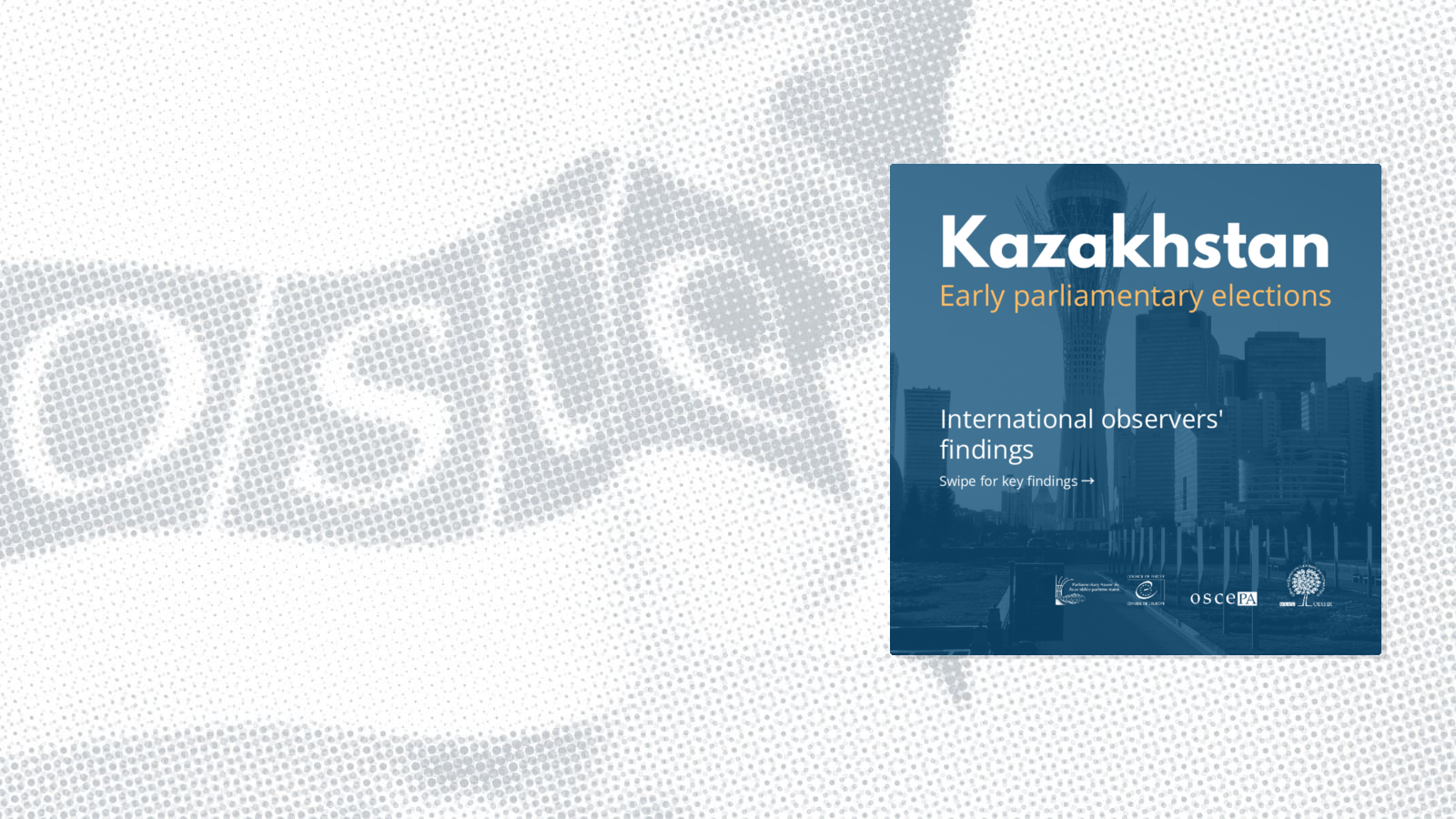
Watch the recording of the press conference presenting the international observers’ preliminary findings and conclusions on the 23 August 2026 early parliamentary elections in Kazakhstan.
What we observe
Election-day observation
ODIHR requested the secondment of 300 short-term observers from OSCE participating States to follow the election day proceedings. The short-term observers were deployed throughout the country in multinational teams of two, which monitored:
- Opening of polling stations
- Voting
- Counting of ballots
- Tabulation of results at all levels
The day after the elections, ODIHR, together with its parliamentary partners, issued a statement of preliminary findings and conclusions at a press conference. A final report on the observation of the entire electoral process will be issued several months after the end of the observation mission.
Long-term observation
The mission is led by Ambassador Vincent Piket and consisted of a core team of 12 experts based in Astana. In addition, 22 long-term observers were deployed throughout the country from 18 July.
The mission assessed the early parliamentary elections for their compliance with OSCE commitments, other international obligations and standards for democratic elections, as well as with national legislation.
Observers closely followed fundamental components of the elections such as:
- Election-related legislation and its implementation
- Work of the election administration and relevant state institutions
- Voter registration
- Candidate registration
- Campaign environment and activities, including online and through social media platforms
- Institutional preparedness and effectiveness to detect and address disinformation, foreign and domestic misinformation and interference, co-operation with social media platforms
- Campaign finance, including its regulation, transparency and accountability
- Media environment and media coverage of the elections
- Resolution of election-related disputes
The observers also assessed how prior ODIHR election related recommendations had been considered. The ODIHR EOM conducted qualitative and quantitative monitoring of media coverage of the election campaign, including on social networks.
International observation partners
For election day, the ODIHR EOM joined efforts with the delegations from the OSCE Parliamentary Assembly and the Parliamentary Assembly of the Council of Europe.
The day after the elections, ODIHR, together with its international partners, issued a statement of preliminary findings and conclusions at a press conference. A final report on the observation of the entire electoral process will be issued some months after the end of the election process.
Reports and documents
Find all key documents from ODIHR’s observation of the 23 August 2026 early parliamentary elections in Kazakhstan.

Previous missions in Kazakhstan
ODIHR has previously observed 13 elections and 2 referenda in Kazakhstan, most recently the 2023 early parliamentary elections and the 2026 referendum.
Contact